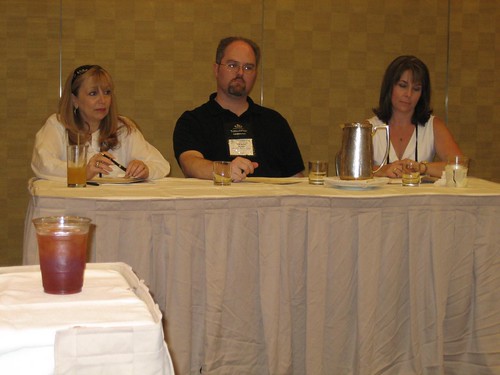
Bouchercon 2010: No contest

For the first time in living memory, two groups have submitted valid bids to stage the Bouchercon mystery conference in the same year. The year is 2010 (which even though it sounds like a far-off science fiction future, is actually only two years away) and the cities are San Francisco and Tempe, AZ.

You can read more about the proposals here:

San Francisco bid
Tempe bid

Having reviewed the information provided by both parties, I find that there really is no contest between the two: the San Francisco bid is superior. It's in a better location and it's run by people with a long-standing connection to the mystery world. (The Tempe folks have a lot of experience in the science fiction community, but apparently none in the crime world.)

I'm also somewhat non-plussed by the programming ideas put forward by the Tempe committee. Although they seem well thought-out, they don't strike me as being especially interesting.

As a result, I believe the San Francisco proposal has greater potential for resulting in a successful and entertaining conference.

(I should note that the committee chair for San Francisco, Rae Helmsworth, is an acquaintance of mine. I don't recommend the bid based on that connection. However, knowing her does favorably impress me regarding her ability to put together an excellent conference.)

The attendees at this year's upcoming Bouchercon in Baltimore will vote to decide which bid is accepted. I urge everyone who's going to be there to show up and vote.

Is ThrillerFest for fans or just authors?

I stopped by a discussion about ThrillerFest over on Murderati where one of the commenters wondered if TFest was a conference just for authors or if it was for fans as well. My two cents...

ThrillerFest is definitely a fun conference for fans to attend. Since ITW is still in the process of building up the attendance base of readers, there is incredible access to the authors for the ordinary fans.

People like Lee Child, Heather Graham, Kathy Reichs, Joe Finder, Barry Eisler and James Rollins (among many others) are just hanging out, standing in the corridors or drinking in the bar. And they'd love the chance to talk to readers.

They aren't constantly mobbed by huge groups of people as so often happens at signings or some of the other conferences. So it's easy to get books signed or take pictures or have a chat. (And they were giving away a ton of free books, so you could get those signed as well.)

Sure, it's expensive -- but everything is expensive. Combine it with a vacation to NYC and you can see the sights AND hang out with cool authors.

Advice I heard at ThrillerFest

One of the best parts of attending a conference like ThrillerFest is the opportunity to sit in on workshops and sessions where people discuss the business of writing and publishing in an open and honest manner. And then, if you hang around the bar long enough, you'll really get the scoop.

Not all of this advice is applicable to every author -- and not all of it is stuff that I necessarily agree with. But it's all worth thinking about and considering.

Communication:

  • Establish a good relationship with your editor, publicist and other people at the publishing house. (This sounds obvious, but apparently a lot of people still don't do it.)
  • Tell your editor what your expectations are and ask them what their expectations are. (This is also information it's essential that you relate to your agent.) Make sure that all of you are on the same page.

Internet:

  • Have a dynamic website.
  • Have a blog. (I'm dubious about this one, largely because of the time involved versus the payoff, but some people swear by it.)
  • Use MySpace and other social networking sites. (I have similar hesitations about this one.)
  • Web advertising is relatively cheap and can be very effective. Consider using a service like AuthorBuzz.com.

Reviews:

  • Know who the reviewers are. Know which outlets review books like yours.
  • Get to know the reviewers on a personal basis.
  • Make sure those people get a copy of your book in a timely fashion.

Networking:

  • Get to know other writers -- they can give you advice, contacts and blurbs.
  • Get to know reviewers, magazine writers, their editors and other assorted media people.
  • (For example: at ThrillerFest, there were two producers from the Glen Beck Show talking to people.)
  • Conferences (whether ThrillerFest, Bouchercon, Left Coast Crime, Love Is Murder, Romantic Times or whatever) are a great way to do this.

Promotion:

  • Play to your strengths; if you're not good at something, don't do it. You'll probably just end up hurting yourself.
  • A big tour might not be feasible (or affordable), especially for a newer author. But you can visit booksellers in your town and those close to your town. If you've got friends or family who'll put you up, maybe you can venture further out as well.
  • Consider writing a short story for an anthology. (For example, ITW is currently putting together two of them, both of which will be very high profile.)
  • Consider writing by-lined articles or book reviews.
  • Most importantly: get your name out there however you can.

ThrillerFest Panel: Shaken Not Stirred: Plots with a Twist

These are the last of my notes from a ThrillerFest panel. The participants discussed spy fiction (in a very general sense) and then branched out from there to talk about writing and other things. Sitting on the panel were Joseph Finder, Barry Eisler, Gayle Lynds, Raymond Benson, Grand Blackwood and moderator Leslie Silbert.

(Note: I didn't take any notes on the discussion of spy fiction. What I wrote down was mostly writing craft stuff, which is what I'm including here.)

Barry Eisler (on the subject of violence): He writes about characters who excel at violence -- but people who excel at violence have troubled lives. They're not normal people and they're incapable of leading normal lives. So someone like John Rain, who is so adept in one area (i.e., violence), is basically inept when it comes to such basic things as sustaining a relationship with another person. Violence takes its toll on people like him and it's interesting to show that in fiction.

Gayle Lynds (on writing larger-than-life characters): Give the heroes flaws so that they don't become superheroes, and give the villains good qualities so that the reader can understand their motivations, if not actually empathize with them. The key is the make the characters three-dimensional. They can't just be cardboard cut-outs or the audience is going to lose interest. You should work just as hard at developing your villains as you do your heroes. Your protagonist must have a worthy antagonist in order to get the most out of your story.

Joseph Finder (on the kind of characters he likes to write): An everyman character who gets caught up in events that spiral out of control and take over his life. Finder likes to see how his character -- who's basically an ordinary guy -- reacts; how he behaves in that situation. Thriller readers want to read about experts; people who know what they're doing, who have extraordinary abilities -- but who are still ordinary people. So the trick is to make your hero(ine) exciting while not making them unbelievable.

Gayle Lynds: We often see stories that are "ripped from today's headlines." But what's most interesting is to take those stories and then put a fresh twist on them. If people are reading a story in the newspaper, chances are they're already familiar with it, if not tired of it. So why would they want to read it in a novel? So use that idea as a launching point to create something new and different of your own.

Barry Eisler: Your protagonist might do bad things, but by peeking into their heads -- knowing their goals and motivations -- the reader can understand their behavior. This makes the character realer and more accessible. The same can also be true of the antagonist. The reader needs to understand why the villain is doing what he's doing in order to make him an intriguing adversary.

Joseph Finder: The old saying is that "truth is stranger than fiction" -- but fiction had better be more exciting. Thrillers focus on the most exciting characters, in the most exciting circumstances, doing the most exciting things.

Grant Blackwood: The reader needs to understand the antagonist's motivation. By understanding the actions of the villains, by getting a peek behind the curtain, the reader's interest in the story will increase, as will the dramatic tension.

Joseph Finder: The "ticking bomb" makes for a great plot device -- a great MacGuffin as Hitchcock used to say. But in order for the reader to care about that scenario, the story must have compelling characters. The characters are what matter most of all. The fact that a bomb is going to explode in New York City isn't very exciting unless the hero(ine) knows it's going to happen. It's by seeing the scenario through their eyes that the reader becomes invested in the story.

Panel Question: What one thing does a thriller need?

Barry Eisler: Thrills.
Joseph Finder: A character you care about.
Gayle Lynds: Structure.
Barry Eisler: And sex.
Grant Blackwood: Larger than life characters.
Raymond Benson: Pace; forward momentum.

ThrillerFest photo

Tfest_group
Barry Eisler, David Montgomery, Gayle Lynds, Otto Penzler

Photo is copyright Alan Jacobson.

(I didn't have a camera, but Alan was kind enough to send me this photo.)

ThrillerFest overview

Looking back on this year's ThrillerFest conference, I have almost all positive things to say. I think it was a well planned and well run event. The consensus of people I spoke to was that it was an improvement over last year's conference, which I would agree with. I think ITW is starting to get some of the kinks worked out and really building something nice.

There are still some areas that are less-than-ideal. It's very expensive (which there's not really anything you can do about. Yes, having it in NYC adds to the cost. But it's not like Bouchercon this year is cheap, and that's in Baltimore for crying out loud). There is the perennial challenge of how to produce interesting programs involving authors that don't involve panel discussions. (If there is a solution to that problem, I don't know what it is. Bottom line: 99% of authors can't do anything interesting other than sit on a dais and talk about their books. And a lot of them can't even do that.) And there's also the challenge of attracting more readers/fans and not just a bunch of aspiring writers.

For me, those factors were more than offset by the many positive aspects of the conference. The opportunity to learn about writing and publishing from so many top people in the business is invaluable. Where else do you have so many great and popular writers teaching classes and appearing on panels? Or have a chance to talk to top agents, editors, reviewers and other professionals? (Note that Bouchercon offers some of these opportunities as well, which is why I often attend it, too.)

Attending a conference like ThrillerFest is not something I'd say you need to do every year. But if you have a chance to make it to one, and you're interested in writing suspense fiction or you're a lover of the thriller genre, I think it's worth it.

ThrillerFest Panel: The Writer-Publisher Partnership

One of the more interesting panels I attended at ThrillerFest was on the Writer-Publisher Partnership, and it included some of the best people in the business: Simon Lipskar (agent, Writers House), Mark Tavani (editor, Ballantine), Meryl Moss (publicist), Linda McFall (editor, Mira), Roger Cooper (publisher, Vanguard) and moderator M.J. Rose (author and marketing guru).

The discussion was fast and in-depth and I didn't have the chance to take great notes. But here are some of the things I scribbled down:

Simon Lipskar: It's dangerous to assume that authors must be genius self-promoters. It's important to be a partner in the process, but you don't need to overdo it. Obviously it's great if you have the ability to attract 10,000 fans on MySpace or you can get TV attention or you're a glib public speaker or whatever. But you don't have to be able to do those things in order to be successful. Listen to what your publisher asks of you and be open to their needs -- and make sure you do what they ask.

Linda McFall: Authors need to do their homework before their first novel is published (and continue doing it afterward). You need to learn as much as you can about the process and the timeline of how things work. You need to talk to your publisher, have open and honest conversations, ask questions and listen to what they have to say.

Mark Tavani: Authors need to talk to their agents and prospective publishers about how each of them sees the book. Sometimes an editor will see the book in a very different way from how the author sees it -- and that's a recipe for trouble. (If you see the book as a breakout bestseller and they see it landing solidly on the midlist, neither one of you is going to be happy.) You need to be honest and upfront about your expectations, hopes and plans. And the editor should do the same. Communication is the best way to avoid problems.

Simon Lipskar: It's the agent's job to serve as an ambassador and diplomat for the author. The agent is the one who can ask the really tough questions and say the difficult things. It's not always best for the author to do those things him/herself. So don't be afraid to talk to your agent and tell him/her about your expectations.

(This notion of expectations, both on the part of the author and the publisher, came up a lot. Some of the biggest problems and bad feelings arise when the publisher and the author have different expectations of what the other is going to do. In order to avoid this -- in order for the writer-publisher partnership to work -- it's essential to have as open and honest of communication as you can.)

Meryl Moss: Although it wasn't always the case, publishers now generally welcome the participation of an outside publicist in the publishing process. (One paid by the author.) You should decide early on if you believe you need the services of an outside publicist. Talk to your agent and other authors and your editor to decide if it's best for you (and also who to hire). If you decide to use a publicist, bring him/her onboard early in the process and make sure your publisher supports what you're doing. (Without the support of the publisher, it's very difficult for an outside publicist to do her job.)

Roger Cooper: His company works with a different business model than the typical publisher. They are very selective and only publish one or two books per month -- and those books get their full attention. They don't pay advances. They pay a higher royalty rate, and they pay those royalties monthly. They outsource both editing and publicity. It's certainly not a model that would work for every author. But the publishing industry should be more open to trying new things, especially given how poorly the current model works.

Further thoughts:

  • It is the book that counts most of all. The author's number one responsibility is to write the best book s/he possibly can. All subsequent discussions continue from the point at which we assume that the author has done his/her job.
  • Most people seem to agree that there are too many books being published.
  • It's impossible for every book to receive ideal publication (marketing, co-op, tours, reviews, etc.).
  • If the author and the publisher are on the same page, it's likely that the experience will be better for both parties.
  • If the author doesn't feel that his/her book is getting the support from the publisher that it deserves -- and virtually every authors feels this way -- there's very little that you can do about it.

(Note that I'm paraphrasing what everyone said. None of these statements should be construed as being direct quotes. But I think I got the sense of it down accurately.)

CraftFest Talk: What Editors Do After Your Book Is Perfect

Here are my notes on a second talk at CraftFest, part of the ThrillerFest conference put on by ITW. It was given by Neil Nyren, Editor-in-Chief and Publisher of Putnam. The topic of his discussion was "What Editors Do After Your Book Is Perfect."

Nyren broke down into three main areas what your editor will do for you: Timing, Packaging and Marketing.

Timing:

  • It's the responsibility of the editor to ensure that the book is published at the right time.
  • A book must be published at the right time in order to be successful.
  • For example: a lot of books by big name authors are released in September-November in order to capitalize on the Christmas buying season. As a result, many books are moved up to August or back to January to avoid the juggernauts.
  • Timing affects how many books are likely to be bought, how much co-op space is available and how much review space is available.

Packaging:

  • Packaging includes the book's size, title, jacket (including color, image, size and style of the author's name and the book's title, author photo, etc.), etc.
  • The editor oversees all of these.
  • (Note: Neil discussed this point using a lot of visual examples, showing different jacket covers and explaining the different aspects of them and why they were done that way. But you'll just have to trust me on that one, as I can't replicate what he said.)

Marketing:

  • The marketing for an author can't be allowed to grow stale. The formula must be updated with every book. What you did last time isn't necessarily what you should do this time.
  • Some considerations are things like: the book tour (bigger or smaller), the type of media opportunities that you pursue, the types of advertising, the outreach to online booksellers or B&M booksellers.
  • If you did it one way last time, you should do it a different way this time.
  • The goal is to make the author appear fresh; make it new/different each time.
  • Co-op (co-operative advertising, where publishers pay bookstores to promote their books) is the great "hidden" cost of publishing. It is very expensive and it is also essential to the success of a book.

Further thoughts:

  • The dark secret of publishing is that even the professionals are surprised every day. Great books fail while crap succeeds and there's no way to tell when that will happen. Conversely, some sure bestsellers flop while real art flourishes.
  • Book sales are tepid. The current state of publishing is described by the quip: "Flat is the new up."

Advice to authors:

  • Work with your editor. Your editor is your connection to the rest of the publishing company and you need to work on having a good relationship with him/her.
  • Do your homework, learn the business. Educate yourself.
  • Then ask questions. Inform yourself and always communicate with your editor.
  • But don't be neurotic. Don't be a pain in the ass. And don't harass your beleaguered publicist.

What do you bring to the table? (factors that influence what a publisher can do for you and your book)

  • Do you or the book have an interesting hook? (E.g., FBI agent, topical story)
  • Do you have an in with a magazine or newspaper or book review editor or media people?
  • Do you know any booksellers?
  • Are you TV friendly?
  • Are you outgoing and a good speaker?
  • What's your sales history like?

(I know this is disjointed -- my notes weren't great and Neil's talk was complicated. But maybe you'll find some of this interesting.)

A good reason to go to ThrillerFest -- free books!

Books_2 A couple of these are books that authors gave me, but the rest were just being handed out. It was ARC city! As I was picking them up, I kept reminding myself: "They'll send these to you at home, Dave. You don't need to schlep them around." But it was nice to get several of them signed.

I've already read the first 100 pages of Sean Chercover's Trigger City (the sequel to Big City, Bad Blood) and it's excellent.

CraftFest/ThrillerFest

I've got posts on a couple more things from CraftFest and ThrillerFest planned. I haven't had a chance to type up my notes yet. But I hope to get to them soon.

The event has been very nice so far. Things are running smoothly and the attendance seems pretty good (although the attendance at some of the panels hasn't been as good as it could be).

I've found it to be an interesting and quite entertaining conference thus far. I was on a panel this afternoon about "How Do Books Get Attention," focused mainly on reviews. It was very well attended and had some good, spirited discussion.

So I give it positive marks. We'll see how the awards banquet goes this evening -- hopefully that won't eliminate all my good will.

CraftFest Talk: The Six Biggest Mistakes Even Bestselling Writers Make

I'm attending CraftFest, part of the ThrillerFest conference put on by ITW this weekend in New York. This morning I sat in on a talk given by bestselling thriller writer Joseph Finder, the topic of which was "The Six Biggest Mistakes Even Bestselling Writers Make."

It's been a long time since I was in school, so my note-taking skills have atrophied...But here's what Finder discussed.

MISTAKE #1: The Passive Hero

  • Too many thrillers have heroes who don't act; they remain passive while events take place around them.
  • The hero must advance the plot; s/he must take action.
  • The hero can't simply investigate what's going on -- he must do something about it.

MISTAKE #2: The Long Setup

  • The story takes too long to get moving.
  • Authors shouldn't just dump story on the reader; they should reveal it through action.
  • Too many books start with a good opening, but then slow down to a crawl.
  • One way to avoid this is to start the story as late as possible. If necessary, you can then go back and fill in details later on.

MISTAKE #3: The Weak Second Act

  • Too many books bog down in the middle, degenerating into repetitive conflict and simply regurgitating the same plot points over and over. The characters aren't progressing and changing.
  • The conflict of a plot must progress and escalate; the plot points must change and vary throughout the narrative.
  • This escalation of conflict, as well as variance of conflict, will not only keep the reader's interest, but help to develop and reveal character as well.
  • The introduction of subplots will also help keep the second act moving.
  • Whenever things start to get dull, remember: REVERSE, REVEAL, SURPRISE.
  • Every scene must advance the plot.

MISTAKE #4: Predictability

  • Authors should never underestimate their readers, most of whom have read a lot of books and seen even more movies and TV shows.
  • Readers know the tropes and cliches of the genre. If the story is predictable, they'll see where it's going a long way off and get bored.
  • The key is to surprise them. Veer off from the expected course.
  • If the obvious development is to take the plot in a certain direction, consider taking it in a different direction instead.
  • One way to avoid this trap is not to over-outline. Be spontaneous in your writing. Allow the characters and the plot to surprise you.

MISTAKE #5: The Lousy Ending

  • Too many books send the reader off on a sour note by finishing with a lousy ending.
  • A great ending is second only to a great beginning in importance.
  • The ending should not consist of explaining everything that happened before or tying up all the loose ends.
  • You should explain as little as possible; let the reader figure out the smaller details on his/her own.
  • Great endings off have symmetry to the beginning.
  • Twists can be good, but they must be earned. They must be set up earlier in the book and prepared for.
  • When you finish the book, get out of there ASAP. Don't draw things out.

MISTAKE #6: Showing Off

  • Too many writers make the mistake of: "I've done the research; I'm going to cram it all in there."
  • You should tell the reader the minimum they need in order to understand the plot; just the tip of the iceberg.
  • Pare it down, leaving only the juiciest nuggets behind.
  • Too much info will only slow down the story.

BONUS MISTAKE #1: Overly Explicit Dialogue

  • People don't narrate a story when they speak; they don't dump details and information.
  • People speak elliptically. Watch out for expository dialogue.

BONUS MISTAKE #2: All Plot, No People

  • The story won't matter if we don't care about the characters.
  • On its own, the plot is abstract; it requires the characters to make it real and make it matter to the reader.
  • Also, the stakes of the plot must matter to the characters in order for us to care as readers.

BONUS MISTAKE #3: Action Is Boring

  • Unlike in film where action scenes can be exciting, in books they too often are boring.
  • What is interesting to the reader is how the characters react to the action and how they interact with each other.
  • There should also be variety in your scenes; don't follow an action scene with another action scene and another action scene. Vary the pace, vary the types of scenes, slow down and speed up in order to give the reader a break and keep them interested.

BONUS MISTAKE #4: Backstory Dump

  • Don't make the mistake of dumping the characters' backstory on the reader all at once. It will bring your plot to a halt and bore the reader.
  • Reveal the backstory slowly, in pieces, as necessary.
  • Drop references in here and there; include mentions in dialogue; intersperse little details throughout the plot.
  • There is always a trade-off of CHARACTER vs. PACE.
  • It's importance to find the balance of revealing enough about the characters in order to make them interesting and make the reader care about them, versus the need to keep the plot moving.

It was a very interesting talk. I hope you find this shorthand version useful.

Are writers conferences worth the money?

One of the perennial topics that mystery/thriller writers talk about is: Are writers conferences worth the money? It just came up in two conversations I had with authors last week.

I used to be a firm advocate of conference-going. I saw it as an efficient and relatively easy way for authors to interact with a large number of fans all in one place. And that's still true -- a well attended conference will provide that opportunity.

But is it worth the cost, both in terms of time and money? That's not as clear-cut as I once thought it was. If you count up the financial cost -- ballpark figures: $300 airfare, $600 hotel, $200 registration fee, $200 food -- you're looking at easily spending over $1000 for a 3- to 4-day long conference.

Now, a grand isn't a huge amount of money. Most of us can afford it. But does it make sense to spend it when you're only getting a $10,000 advance? Even if you're get $50k per book, is it advisable to spend $1k of it all in one place?

I don't know. Maybe -- maybe not. Those are the kinds of questions authors have to ask for themselves. But it's important to weigh the positive benefits against the financial costs (and certainly the opportunity costs) before deciding to sign up.

I love attending writers conferences. I always have a good time. But I don't look at them as promotional opportunities. (I don't really have anything to promote.) So if I looked at them in terms of the career benefit they provided me, they wouldn't be worth the money.

But they can be worth it for other reasons. Writers conferences are a chance to get together with friends, socialize, network, talk about the business, learn more about the craft, etc. That is what, for me, makes them worthwhile. Writing is an isolated and isolating endeavor. Many of us go weeks if not months without talking to other writers except through email. Conferences can be a valuable social activity -- kinda like playdates for home-schooled kids.

If that's the case, though, how many of these things should you attend? Do you need to go to ThrillerFest and Bouchercon and Love Is Murder and Left Coast Crime and Dave's Backyard Hootenanny? Probably not. Maybe one a year is worthwhile -- and which one that is will depend on a lot of factors, like location, what type of books you write, who's putting the conference on, who the guests of honor are, who else is going to be there, etc.

I do think conferences provide valuable promotional opportunities, especially for newer writers. You can meet influential people in the business, talk to fans, hopefully generate word of mouth. For more established authors, I think it's probably a good idea to make an appearance at least every couple of years, or else people will start to suspect that you're dead.

But should you attend every one? Or even attend every year? Only if you enjoy going to them a lot -- enough to offset the costs. Otherwise, you're probably better off spending your promotional dollars elsewhere.

Friends of Dave photo

We did a panel last weekend at Love Is Murder that was called Friends of Dave. It was Lee Child, Barry Eisler, Paul Guyot and I talking about books, publishing, Hollywood and other topics of great importance. Here's a picture. (We dragged Tess Gerritsen up from the audience to pose with us. We needed something to class the photo up a little.)

Lim_2

PLBW

What is PLBW? Damned if I know, but it's all the buzz this weekend at Love Is Murder. People are wearing buttons (including me for some reason) with these 4 cryptic letters. But nobody will tell me what it means.

So spill the beans, if you know.

Ask the Critic: Attending writers conferences

Anonymous writes:

Is it worth it to attend a conference mostly to pitch a book or are the publishers present really there to sell books not to buy new ones?

I think most writers conferences, especially the larger ones like Bouchercon and ThrillerFest, probably aren't much use when it comes to pitching publishers. You can make contacts at them -- they're a good place to meet agents, for example -- but the hectic, frenetic nature of such conferences really doesn't lend itself to any kind of formal pitching. Also, editors generally attend to support their authors; they're not really looking for someone to hand them a manuscript.

Some of the smaller conferences, however, do schedule pitch meetings with representatives from publishers. They do that at Love Is Murder, for example, where attendees can register for pitch sessions with Bleak House Books, Tekno/Five Star Books and Echelon Press. If you're interested in one of those publishers, then attending the conference might prove to be a great deal of help.

I think that, for aspiring writers, conferences are most useful for making contacts, learning more about the craft and the business of publishing, talking shop and just enjoying the camaraderie of fellow writers. For that, they can be invaluable.

If you've got a question for Ask the Critic, please send it in.

Lessons learned from the industry panel at ThrillerFest

These are things that people on my panel brought up. I wasn't taking notes, so this is all from memory.

Co-op is everything. Co-op is the industry term for cooperative advertising money. This is money paid by the publisher to booksellers in order to stock their books (in the case of airports and similar) and to give their books prime placement (in the case of bookstores). If you see a book in the front of B&N, it's likely that the publisher paid them to put it there. Co-op is the most expensive and the most important part of advertising that any book will receive. It is crucial for a book's success.

It's almost impossible to say how many books it takes to make the New York Times bestseller list. It varies wildly from week to week, depending on the competition. It's possible that you might make the list with as few as 7000 books sold in a week. But other weeks a book might sell many more than that and not even get close. (I did hear from a trusted source, not on the panel, that it takes a minimum of 35,000 books shipped in order to have a chance to make the list.)

Although making the New York Times list is important, it's more important to sell a lot of books. More books sold is always better than a higher ranking. It also doesn't matter if the book gets all its sales up-front, or if it gets them over the course of months. The total sales is what matters in the end.

Timing is very important to a book's success. (And that's why there are hardly any books being published this week -- everyone is staying away from Harry Potter.) The competition a book faces, especially in the initial weeks, can determine its fate. Thus the publishers track when everyone is publishing their books and schedule their own releases accordingly. The late fall is an especially busy time for big-name books.

Be nice to your editor. It's not her fault if the book does poorly. Also, be nice to your editor's assistant. They will often give authors information they aren't supposed to have, especially if the editor is on vacation.

BookScan numbers can be unreliable, but there is disagreement as to how unreliable. They probably track around 60-70% of sales, but this can vary depending on the type of book. (A subscription to BookScan, by the way, runs 6 figures annually.)

Online sales aren't very important for bestsellers. For someone like Tess Gerritsen, Amazon only represents 3% of total books sold. Also, Amazon rankings don't mean much. A book can jump significantly with only minimal sales.

The big box stores (price clubs, WalMart, etc.) are extremely important for mass success. If a book isn't sold in those stores, it's unlikely to be a bestseller. Sales through those outlets amount to as much as 40% of a bestseller's total sales. However, for first-time or unknown authors, the chance of your books being sold there is very small. So don't expect it.

The cover of a book is the single most important factor in closing customer sales. Covers are often a contentious topic between publishers and authors, and publishers don't do much in the way of market testing to find out what works. (The publishing industry in general doesn't do much market research.) If an author is going to complain about a cover, it's best to have specific areas of objection, and suggestions for improvements. Bestselling authors like Gerritsen can get cover approval, but new authors cannot.

It's hard to get your book reviewed if you're a first-time author. It's hard to get your book reviewed if you're an unknown author. It's hard to get your book reviewed no matter what! (It's not impossible, though. And it helps if the book is interesting and fresh.)

The best way to get your book reviewed, and the best way to have it be a success, is to write the best book you possibly can. And that is the one area of the process over which an author actually has control.

Back from ThrillerFest

I'm home and recovering from ThrillerFest. I had a great time, and thought the conference was very good, but it was a long weekend. I'm not complaining, though, as it's nice to spend some time with grownups for a change.

I spoke to scores of interesting people, including writers, publishing people and fans, which is the reason to go to these things. The panels are fine, but what goes on the corridors, bars and restaurants is what I'm really interested in.

I'll only drop one name from the weekend: James Patterson. I didn't talk to him, though, so it's not much of a namedrop. We were at a cocktail party and I was going to go say hi (we were on a panel together at BEA last year), but by the time I got around to doing it, he was gone. At the same party, I did talk to Jeffrey Trachtenberg (who writes about publishing for the Wall Street Journal) and he was a nice, interesting guy.

I have to say that I thought the panel I was on was fascinating. (And not just because I was on it, as I didn't even talk that much.) It was the only industry-oriented panel of the conference, so there was great turnout and a lot of interest from the attendees. I enjoyed it a lot just sitting up there listening to the other panelists, and the folks in the audience seemed to as well. We could easily have kept going for another hour or two.

The only part of the weekend that I didn't enjoy was the banquet. That's 6 months of my life I'll never get back.

Obviously attending conferences like this can be expensive, but I still think they're an invaluable experience for authors, aspiring writers and superfans. There's just no other way to see so many of the people from our industry together in one place.

(Not many details, I know, but if anyone has any questions, I'll try to answer them.)

ThrillerFest this weekend

ThrillerFest, the world's numero uno gathering of thriller writers, readers, fans and professionals, is going to be held this weekend in NYC. It's not too late to make plans to attend.

You'll have the chance to see dozens of your favorite writers in action (James Patterson, Clive Cussler,  Jeffery Deaver, Lee Child, Heather Graham, Vince Flynn, etc.), plus many top industry professionals, including agents, editors, critics and more.

Check the link for details.

My panel should be very interesting:

Sunday, July 15 @ 10:00am:
The Snare of the Hunter: How writers and publishers work to get you to buy their books

Jason Pinter, Author/Editor at St. Martin's Press
Tess Gerritsen, Author
M.J. Rose, Author/Marketing guru
David Montgomery, Critic
Matthew Baldacci, Director of Marketing at St. Martin's Press
Neil Nyren (Panel Master), Publisher and Editor in Chief of Putnam

I hope to see some of you there!

If you're looking for me: check the bar first.

ThrillerFest 2007

ThrillerFest 2007 is coming up next month in New York City. There will be a fine line-up of guests attending, including moi.

They've just posted the full schedule online. Here's my panel:

Sunday, July 15 @ 10:00am:
The Snare of the Hunter: How writers and publishers work to get you to buy their books

Jason Pinter, Author/Editor at St. Martin's Press
Tess Gerritsen, Author
M.J. Rose, Author/Marketing guru
David Montgomery, Critic
Matthew Baldacci, Director of Marketing at St. Martin's Press
Neil Nyren (Panel Master), Publisher and Editor in Chief of Putnam

Not a great time slot, but it should be an interesting panel. Looking over the schedule, this appears to be the main panel discussing the business end of the industry.

I hope some of you will be able to attend.

Top Ten Reasons to Go to Thrillerfest

ThrillerFest is only 3 months away -- are you excited yet? Dave White has shared his "Top Ten Reasons to Go to ThrillerFest" and asked others to do the same. So here goes.

1. Have a chance to buy me a drink. Who knows, maybe I'll review your next book.

2. Touch Barry Eisler's hair. He really doesn't mind if you run your fingers through it. It's quite silky.

3. Ask M.J. Rose if she's really tried out all those kinky sex things she writes about in her books. (Hint: the answer is yes.)

4. Steal ARCs. Many authors in attendance will have ARCs of their new books with them. Those same authors can frequently be found in the bar, three sheets to the wind. You do the math.

5. Meet James Patterson. I hear he's looking for another co-writer. Maybe it could be you!

6. Ask Lee Child how his last-place Yankees are doing. Oh, that's right. They're in last place.

7. See New York, one of the world's finest cities. Admittedly, I won't leave the hotel the entire time...but you could.

8. Follow agents into the bathroom and pitch them your manuscript. I've heard this is how most writers got an agent, so it should work for you, too.

9. Ask Jim Born if you can touch his gun. He'll know what you mean.

10. Did I mention you could buy me a drink?

I hope to see many of you there!

PSA: ITW's Brunch & Bullets

The following is a public service announcement.

International Thriller Writers (ITW) presents Brunch & Bullets on May 5th in Greenwich CT at 11AM.

Where readers (young and not so young) break bread with thriller writers and live to tell the tale!

On May 5th, International Thriller Writers is honoring ITW's own R.L. Stine with a Silver Bullet Award for the amazing contribution he has made to fostering the love of reading in tens of millions of young people over the course of his wondrous career.

Special kids' meals will be available and, more importantly, so will R.L. Stine himself!

Authors in attendance for the adults in the group, will be Michael Palmer, Doug Preston, Joseph Finder, Stephen Coonts, Lincoln Child, F. Paul Wilson, Jim Fusilli, Wendi Corsi Staub, Peter Spiegelman, Peter Blauner, Chris Grabenstein, Jon Land, Carla Negers, Lawrence Light, M.J. Rose and Linda Fairstein (tentative).

Where: The Hyatt Regency Greenwich in Greenwich, Connecticut.
When: May 5th @ 11:00am - 2:30pm.
Why: To entertain and help raise money for Reading is Fundamental. 25% of the event's net proceeds will be donated to local chapters of Reading Is Fundamental.
Plus: The registration fee includes a $25 voucher good at the book signing that will close the event at 2:30.

Register here:
http://www.regonline.com/Checkin.asp?EventId=116819

Virginia Festival of the Book

Once again this year, I'll be participating in the Virginia Festival of the Book, one of the country's best-run and most entertaining literary festivals. I attended last year for the first time and really enjoyed myself. The Festival is interesting, it's eclectic and it's free! You can't beat that.

I'm moderating two panels this year, both on Saturday, March 24th:

10:00am - Murder in the Mid-Atlantic

Mystery writers Raymond Austin (Your Turn to Die), John Billheimer (Stonewall Jackson's Elbow), Ellen Crosby (The Merlot Murders), John Lamb (The Mournful Teddy), and Vicki Lane (Art's Blood) discuss their fiction set in this region.

4:00pm - Sex, Lies, and Violence

With mystery and thriller writers Barry Eisler (The Last Assassin), Matthew F. Jones (Boot Tracks), Lisa Unger (Twice), M.J. Rose (The Venus Fix), and Robert Walker (City for Ransom).

They both look like they should be interesting panels, so I'm looking forward to them. The second panel, in particular, looks good...'cause, you know, we'll have the chance to talk dirty.

Among the other crime authors in attendance will be Lee Child, Tess Gerritsen, Laura Lippman, George Pelecanos, John Hart, Bob Morris, David Simon and many more. If that doesn't get you excited, you must not like crime fiction.

If any of you are going to be in Charlottesville, or live anywhere near there, it's definitely worth a trip. Please stop by and say hello.

Virginia Festival of the Book

It's just been announced that Lee Child will be the featured speaker at the Virginia Festival of the Book's Crime Wave program, to be held next March in Charlottesville.

The VA Book Festival is a wonderful five day-long festival devoted to authors, books and publishing. On Saturday, they have a whole day devoted to crime fiction. I went last year for the first time and really enjoyed myself.

You get a chance to meet a lot of great writers, readers, publishing people, librarians and other people who love books -- and, best of all, it's free!

You do have to buy the tickets to the luncheon that Lee is speaking at, but most of the other events, including the panels, have no charge. You just show up.

Last year's line-up included people like Michael Connelly, Jeff Deaver, John Lescroart, Karin Slaughter, Michele Martinez, Bob Morris, Nancy Martin, Susan McBride, and a bunch of other people I can't remember off the top of my head.

I will probably be there again next year, moderating a couple of panels. So if you've always wanted to heckle me, here's your chance.

If you live anywhere near Charlottesville, or are interested in making the trip, I highly recommend it. (And if you plan to go, I suggest buying tickets to the Crime Wave luncheon early -- it's sure to sell out.)

Hope to see some of you there!

A new mystery writer confab

Bob Morris, the excellent Florida crime novelist and all-around terrific guy, has a blog. Okay, that's not much of a surprise, since the only person left on earth without a blog is my sainted mother.

But Bob has made an announcement on his blog that should be of interest to a lot of folks: He's helping put together an author gathering in Eustis, Florida (near Orlando) called Murder and Music by the Lake, featuring a passel of Florida mystery writers, including Randy Wayne White, Jim Born, Jon King and more.

(Separate thought: Why is it that so many damn fine crime writers live in Florida? Is it the humidity? The swamps? The flying cockroaches? What??)

Murder and Music by the Lake will be held next February and it sounds like a lot of fun. I wish I could be there! Unfortunately, now that I'm a papa, I'm not allowed to go anywhere.

I hope it all goes well. Best of luck to those involved.

ThrillerFest 2007

This just in... Next year's ThrillerFest will be held at the Grand Hyatt in New York City on July 12-15, 2007.

Be there or be square!

ThrillerFest Marketing Panel

M.J. Rose, David J. Montgomery, Sarie Morrell (photo credit: J.T. Ellison)

I was on the Marketing Panel at ThrillerFest, along with author/marketing guru M.J. Rose and publicist Sarie Morrell.

Here is some of the information that came out during the panel:

  • No single strategy works for everyone. There is no magic bullet. Lots of little things can add up to success.
  • Authors need to spend a portion of their advance (at least $5000) on marketing themselves and their book.
  • Authors need to become marketing partners with their publishers.
  • When talking to your publisher, don't demand. Offer.
  • Advertising can help, but you need to be careful about how you spend your money. If you're going to invest in ads, you really need to know what you're doing.
  • A one-time ad in the New York Times is not going to do much for you. Something like AuthorBuzz is a better investment.
  • A professional-looking website is essential. It doesn't have to be fancy or expensive, though. Don't spend all your money on this.
  • Authors should do everything within reason to make sure reviewers receive their book. Never assume that your publisher will take care of this, even if they tell you they will.
  • Your in-house publicist is incredibly busy and is likely working on dozens of books simultaneously.
  • Find out who the reviewers are who write the most about your genre. Get them your book, even if you have to send it yourself.
  • Independent publicists can help, but you need to make sure you get a reputable one.
  • Authors must be realistic about what a publicist can do for them, and understand where they are in their career and what they can expect. There are no guarantees.
  • Don't feel bad if you can't do as much as J.A. Konrath!

Above all, I would advise every writer to educate themselves as much as they can about this business. Ignorance is a sure path to failure.

ThrillerFest Round-up

Like Jason and Sarah, I'm just going with the bullet points for my ThrillerFest round-up:

  • The program was a smashing success and I was very proud of the hard work that everyone did. I didn't get to see all the panels, of course, but the ones I did see were good.
  • The Readers Panel -- featuring Rae Helmsworth, Janine Wilson, Paul Turner and Nancy Slusar, and moderated by Gregg Hurwitz -- was one of the best panels I've seen at a conference. I'd like to see more of that in the future.
  • ITW took the time to recognize my outstanding service to the organization. They gave me a beautiful award. Everyone applauded. I was not there.
  • You know you're someplace cool when Jeffery Deaver just happens to be stopping by to say hello, even though he's not attending the conference.
  • Reed Coleman, a true gentleman and a fine writer, put to rest any nonsense about a feud between ITW and MWA. It simply isn't true.
  • My copy of the Thriller anthology has been signed by 26 of the 32 contributors. Unfortunately, I missed Alex Kava at the conference, but I got everyone else who was there.
  • R.L. Stine is a very funny guy who tells a good story.
  • Brad Meltzer is also a funny guy who tells a good story -- and I didn't believe a word of it.
  • Clive Cussler had great stories as well. I don't know if they were true or not.
  • It really is that hot in Phoenix. I lived in Bakersfield for 20 years, where it often breaks 100 degrees in the summer, and Phoenix is even worse. You never do get used to it.
  • The Killer Year folks -- a group of debut authors with books out in 2007 -- are nice people and have excellent taste in critics.
  • The Arizona Biltmore is a great hotel/resort, but they need better air conditioning in the main building. My gorgeous room, on the other hand, was like a meat locker. And I loved it. I woke up in the morning and the ice in my ice bucket was still frozen, even though I left the lid off.
  • Having editors ask you, "So, what's your book about?" is a guaranteed tongue-tying moment.
  • Several thriller writers have wives who are much better looking than they are. Since I am one of them, I can't complain.
  • Lee Child, Joseph Finder, Barry Eisler and M.J. Rose make wonderful dinner companions. Talking with them was like getting a master's class in publishing.
  • When Jim Born shouts, "Police! Don't move!," you don't move.
  • Michele Martinez must have been one helluva good prosecutor. I'm glad that I never committed a crime in her district.
  • Even Lee Child admitted that Jack Reacher was guilty. I still voted to acquit, however, as I'm a contrarian at heart.
  • The Awards Banquet wasn't as bad as I thought it would be. And Michael Palmer and his son Daniel are actually talented musicians.
  • A Tanqueray and Tonic still tastes damn good when it costs $8. But it tastes even better when someone buys it for you.
  • You know how people are always saying, "I owe you a beer"? Apparently they don't mean it. I have made the appropriate notations on my Naughty List.
  • Everyone was so kind, both about the book and the baby... I was blown away.
  • I'm already looking forward to ThrillerFest 2007 in NYC!

ThrillerFest photo

I stole this off of Tess Gerritsen's site.

Tfest1_1

Left to right: Michael Palmer, Chris Mooney, me, Gregg Hurwitz, Tess Gerritsen

I thought that was a pretty good picture of me, so I wanted to share it.

ThrillerFest feedback

For those of you who attended ThrillerFest, if you have any comments on the programming that you'd like to share -- positive, negative, whatever -- or any suggestions for next year, please feel free to contact me. I welcome your feedback.

I'm not doing the programming for 2007, but I can share suggestions with those who are.

Also, since I'm posting, let me extend a hearty congratulations to the winners of the first annual Thriller Awards:

Best Novel - THE PATRIOT'S CLUB by Christopher Reich (Delacorte Press)

Best First Novel - IMPROBABLE by Adam Fawer (William Morrow)

Best Paperback Original - PRIDE RUNS DEEP by R. Cameron Cooke (Jove)

Best Screenplay - CACHE (Hidden), screenplay by Michael Haneke

Also, the first ThrillerMaster Award went to Clive Cussler.

I was one of the judges for the Best First Novel award, and I found it to be a very rewarding experience. Improbable is a terrific debut novel and I look forward to reading more from Fawer in the future.

Back from ThrillerFest

I arrived home early this morning (late last night? What is 2 am?) after catching an afternoon flight out of Phoenix. ThrillerFest was a big success and people really seemed to enjoy themselves. I thought the programming turned out quite well (Yes, I'm patting my own back) and the writers in attendance were great. I also had a chance to meet some readers who really know their stuff. (Even I'm impressed when I meet a fan and she says she reads 200 books a year!)

I think conferences like this are a great opportunity for people, whether they're writers or readers. If you're a writer, it's a wonderful chance to meet knowledgeable readers, learn about the business, and enjoy the camaraderie of fellow writers. If you're a reader, it's a rare chance to meet and talk to some of the biggest names in the business, and learn more about these books we love.

I might post something more about the conference later, but I don't feel very well right now and I'm exhausted. In the meantime, Sarah Weinman's written some about it, as has Lee Goldberg.

Writers Conferences

I'm off to Phoenix next week for ThrillerFest, the inaugural conference for ITW (International Thriller Writers).

Writers conferences are a lot of fun and a wonderful opportunity to meet interesting people and talk about the crazy business of writing and publishing.

If it's your first conference, prepare to be overwhelmed. Don't let that discourage you, though, from jumping in feet first.

A few suggestions for getting the most out of the conference:

  • Don't forget to sleep & eat! It's easy to neglect the essentials during one of these whirlwind, non-stop conferences, so take some time to take care of yourself.
  • Introduce yourself to people, even if you're intimidated. Authors come to these things to meet readers, so they want to talk to you.
  • Keep your ears open. You can learn a lot at conferences, so make sure to listen.
  • Drink lots of water. You can't survive on gin & tonics alone for a whole weekend. I've tried.
  • If you're looking for someone and can't find them, check the bar. Most people are in the bar.
  • Even if you don't drink, you can still hang out in the bar. Nobody will think you're weird.
  • Don't introduce yourself to people as a "pre-published writer." They will laugh at you.
  • Don't tell people you hated their book. And definitely don't explain in detail why you hated their book. It's rude.
  • If you're looking for Lee Child, check outside. He loves the heat and they won't let him smoke inside.
  • Attend any panel that I'm on. My panels are always interesting and informative. And if you can't attend my panel, don't miss Barry Eisler's. If nothing else, you can admire his hair.
  • Always buy the critic a drink. S/he's probably the most interesting person in the room.
  • Pace yourself. Always pace yourself. Otherwise, you might be dead by the end of the weekend.

Above all, remember to have a blast!

BookExpo America

I spent the weekend at BEA (BookExpo America), the publishing industry's incredibly large trade show, and thought I'd write something about it. The truth is, that I'm exhausted, but I'll write as much as I can.

You've never seen so many books or so many people that work with books. It truly boggles the mind. Walking around, staring at the thousands upon thousands of titles, you can't help but wonder "Who reads all these things?" (And, of course, the answer in many cases is: no one.)

But I had a wonderful time, picked up a few new books, and talked to a lot of very interesting people. My panel on The State of the Thriller went well. I don't think my rambling response to one of David Morrell's questions made any sense, but I'm not sure it mattered. (I wasn't at my most articulate during that panel.)

James Patterson was one of my fellow panelists and we talked for a while afterwards. He's an extremely friendly guy and has a lot of very interesting (and smart) things to say about the publishing world. Same thing goes for Dan Conaway, a big shot editor at Putnam. Bright guy, really knows books.

I saw a lot of fine mystery and thriller writers over the course of the two days. (Don't worry: I won't do a massive name drop.) One person I want to mention, though, is Nelson DeMille. Joe Finder introduced us and it was a pleasure to meet a true legend of this business. One of the very first thrillers I read, back when I was a teenager, was DeMille's Word of Honor. He was quite a friendly and gracious man.

Same thing goes for Eric Van Lustbader, whose book The Ninja I read when I was 14 or 15. I spoke to him briefly and he was also very nice. Eric has a new book coming out soon, so it's great to see him publishing again.

Last night I went to a party that Mira threw to celebrate the release of Thriller, the new anthology of thriller stories put together by International Thriller Writers. (Check the book's website to see the list of authors. It's an incredible line-up.) The party was a who's who of thriller writers, including David Morrell, Gayle Lynds, van Lustbader, M.J. Rose, Chris Mooney, Katherine Neville, Steve Berry, James Rollins, Heather Graham, Denise Hamilton, M. Diane Vogt and Robert Liparulo.

I got my copy of Thriller (coming to bookstores soon) signed by all of them, then added F. Paul Wilson and James Grippando today. Eventually, I'd like to get signatures from all the contributors. I'll have a chance to get more this summer at ThrillerFest.

(Okay, that was a big name drop. I hope that satisfies the urge, if you had one.)

BEA is something really extraordinary for people who love books. It's for industry people, not fans, but it's definitely something worth attending if you ever have the chance.

ThrillerFest Panel Assignments

The panel assignments for ThrillerFest are starting to go out, so there will probably be an official announcement of the line-up soon.

In the meantime, if you're pleased with your panel, I take all the credit. If not...well, let's just say the board overruled me.

ThrillerFest Sneak Peek

As regular readers of this blog know, I have been intimately involved in the planning for ITW's inaugural ThrillerFest writers and readers conference. News of what you can expect during the weekend (June 29-July 2) is starting to trickle out, so here's what I can share at this point:

The event kicks off on Thursday afternoon with the writer's craft workshops. There will be eight sessions (two tracks, four sessions each), all taught by top-name thriller authors. Classes include "Writing the Big Thriller," "Common Mistakes Writers Make In Dialogue" and "Writing the Thriller Screenplay."

Following the craft workshops will be Doug Preston's Spotlight Interview with Jim Fusilli. After that, there will be a Welcome Reception sponsored by MIRA and featuring a signing of the Thriller anthology.

Friday features a ton of panels (four tracks worth, running simultaneously). Among them will be Tess Gerritsen's "Crime Scene Extravaganza" and "The Jack Reacher Trial" (starring Lee Child.)

Friday also has the RL Stine lunch, and the evening features David Morrell's presentation on his novel, First Blood, with a special screening of the film.

Saturday will start with Sandra Brown's Spotlight Interview, followed by a series of Special Ops workshops (seminars on Knife Fighting, Delta Force, Street Fighting, the CIA, etc.). There will also be a slew of panels running most of the day.

The afternoon will feature a Spotlight Interview with Brad Meltzer, followed by the star-studded charity auction. Saturday night will be the Thriller Awards Banquet.

Clive Cussler will receive the first ever ITW Lifetime Achievement award. Clive will give a talk, mingle with fans and sign books.

Sunday concludes with the final panel presentations, followed by Brunch with John Lescroart.

So far I haven't been able to confirm it, but I've heard a rumor that there will also be a lot of drinking done. I'll keep you posted on that one.

The line-up of panels won't be announced until late-April, but you can see the authors who will be in attendance on the conference website. (There are some very cool panels planned, rest assured.)

All in all, I think it's going to be a blast! I hope you'll be able to join us.

BookExpo America

BookExpo America (BEA) is the largest publishing event in the country, an annual gathering of thousands of authors, booksellers, librarians and publishing pros. I'm not entirely sure what they all do once they get together, as I've never been before. This year's convention is in Washington, D.C., though, so I'll be there.

I'll be participating on a panel that should be very interesting:

State of The Thriller
Friday, May, 19 @ 2:30PM

"Featuring industry participants from author to bookseller, thriller specialists will dissect the industry’s hottest selling genre. Panelists will attempt to answer where the Thriller genre is headed, which authors are emerging, why thrillers dominate bestseller lists and what we might expect in the near future."

Participants:

  • David Morrell - Author [Moderator]
  • James Patterson - Author
  • David J. Montgomery - Critic, Chicago Sun Times
  • Margaret O'Neil Marbury, Executive Editor, MiraBooks
  • Simon Lipskar, agent, Writerer's House
  • Dan Conaway, Executive Editor, Putnam

If you're wondering what I'm doing on there... Well, I am, too! But at least this is a topic that I can speak intelligently about.

So if you're going to be at BEA, please try to stop by the panel. It should be a good one. And definitely find me to say hello.

VA Festival Redux

Following up on my previous post about the Virginia Festival of the Book, I have a couple more things to add.

First off, the Daily Progress, Charlottesville's local newspaper, covered the festival, including an article on my Publishing Day panel. (Hat tip to Ron Hogan for the link.) The reporter wisely quoted the only interesting thing I said during the entire panel, so kudos to her.

The other thing is that several authors have written to ask whether or not I think the Festival would be worthwhile for them to attend. I think that it would be useful for a variety of reasons:

1) The Festival has writers and readers from all different fields and genres, so you have a chance to interact with people who may not ordinarily read crime.

2) There is a large crime presence at the conference (with several dedicated panels), so there's a lot of readers from our genre. Most of the writers seemed to be getting a good number of fans in their signing lines, and the bookseller on location had a good selection. So it appeared that folks were doing business.

3) The conference is free and is almost exclusively fans/readers, not writers and aspiring writers. So you can talk to people who might actually buy books. (Just to prove this point...  the whole time I was there, nobody came up and asked me to review their book. The only book I was given was by one of my panelists. This is much different from, say, Bouchercon, where I'm inundated.)

So, bottom line, if the organizers invite you to participate, I would strongly consider accepting.

For those of you who are fans and readers, I would definitely urge you to attend the Festival if you ever have the opportunity. It's a great chance to meet some of your favorite authors, and best of all, it's free!

Panel suggestion?

I need one more panel idea for ThrillerFest. If you have a suggestion for a topic that you'd be interested in hearing thriller writers discuss, please pass it along.

The conference is shaping up to be very exciting. There's the Jack Reacher trial (starring Lee Child), the mock autopsy (led by Tess Gerritsen), spotlight talks with Douglas Preston, RL Stine, Sandra Brown, John Lescroart and Brad Meltzer, a slew of exciting panels featuring top thriller writers, Special Ops demonstrations led by real pros from the covert world, writing workshops led by bestselling authors, and more!

If that sounds interesting to you, you should consider attending. There's still time to sign-up. And even if you can't attend, you can still send me a panel suggestion.

Virginia Festival of the Book

I spent the weekend down in Charlottesville at the Virginia Festival of the Book. Although I only live about 2 hours north of there, I'd never made it down for the festival before. This year they invited me to participate, and I was glad I did. It's a fun and interesting conference with a wide diversity of both authors and readers, which made for an intriguing mix of people.

I moderated two panels that were part of the Crime Wave program. As I've mentioned before, I generally prefer to participate on panels rather than moderate them -- I'd much rather just sit there and spout my opinions than do the hard work of running the show -- but I've gotten a rep as being a good moderator, so that's what I usually get asked to do.

Both of the panels I moderated had a terrific line-up of authors, which certainly made my job a lot easier. It's always fun to moderate a panel when the participants are gregarious and interesting and willing to loosen up a little and enjoy themselves (while still giving serious and interesting responses).

The two panels were:

Keeping Up Appearances: Cozy Mysteries
with Nancy Martin, Laura Durham, Susan McBride, Emyl Jenkins and Ellen Byerrum

Pressing Charges: Crime Wave Panel
with Paula L. Woods, Pat MacEnulty, Michele Martinez and Karin Slaughter

The turn-out for both panels was quite good, and the audiences seemed to really enjoy the talks. I got some great feedback from people who attended, including author Joseph Kanon who was at the Cozy Panel. I'd never met him before, so I didn't spot him in the audience, but we spoke afterwards and he said he had a lot of fun.

The other panel I was on was one I did as a participant, as part of the Publishing Day program:

Who’s Reading and How?
with Ron Hogan (Beatrice.com), David Kipen (NEA), me, Gene Schwartz (ForeWord Magazine) and moderator Carol Fitzgerald (Bookreporter.com).

I thought that panel was interesting for the most part, but I didn't feel like I had a lot to contribute. The topic probably would have benefited from a little bit of fine-tuning, although I'm not sure what the programmers were going for. It seemed to me a little too amorphous to really sink our teeth into.

The best part of these conferences is always meeting the interesting people in attendance, and I had some great conversations about books, publishing and writing. The line-up at the conference was truly a distinguished one. (I had dinner one night with a group of writers whose combined book sales who probably circle the globe.)

I'm not going to start dropping names, but I do want to mention that I had the chance to hang out with Digby Diehl, legendary critic from Playboy Magazine, and the inaugural editor of the L.A. Times Book Review. Digby was one of the people who first inspired me to become a critic, so it was an honor to meet him. He's a fascinating and very friendly man.

One of the things that I heard repeated several times by various authors is how well their books are doing overseas, and how much attention crime fiction is getting internationally. It really has become a global market, which is very encouraging for writers. It was also the consensus that the U.S. is the only place where we have this hang-up about genre fiction not being "literary," while elsewhere it's commonly accepted that it is.

In addition to the authors, there were also a great many fans in attendance; most of the audience, in fact was composed of readers. It was really inspiring to see so many people who love books and love to read. Unlike most of the mystery conferences (like Bouchercon), this one wasn't dominated by aspiring writers, so it was fun to get a different perspective from people.

I hope to be back next year!

Love is Murder 2006

I spent the weekend in Chicago at the Love is Murder conference, along with a couple hundred other writers, reviewers, editors and fans. This is the second time I've been to this particular conference, and both times it has been a very good experience.

Among the authors in attendance were David Morrell, Judith Guest, Barry Eisler, William Kent Krueger, Libby Fischer Hellmann, J.A. Konrath, Kevin Guilfoile, David Ellis, Barb d'Amato and a whole slew of other folks.

Love is Murder is geared more towards writers and aspiring writers than Bouchercon, so there are always a lot of panels and discussions focused on the business and craft of writing. And plenty of shoptalk, too, of course.

David Morrell offered a 3-hour workshop in writing, which I found to be particularly enlightening. He also gave the conference's keynote address, discussing "The Hidden Curriculum of Publishing."

I moderated one panel (on Writing Violence) and participated on three others, all of which seemed to go over well with the audience.

I usually enjoy these smaller conferences a lot, as you have the chance to talk to people in a more intimate way. So often at Bouchercon, it's all just nodding and waving from across the room. (Granted, you do get to wave at a lot more people.)

But at Love is Murder, I was actually able to talk to several good writers and friends, including most of the people mentioned above. I also met some very interesting new writers like Sean Chercover, Steve Mandel and Marcus Sakey. They are all terrific guys and now I'm excited to read their books. I also had a great talk with Dave Case, a sergeant with the Chicago PD, who is a new writer I've already read. (His book Out of Cabrini is awesome.)

John and Ruth Jordan (of CrimeSpree Magazine) where there, continuing the admirable work they do on behalf of the genre. They were great to see, as always. I finally met Ben LeRoy and Alison Janssen of Bleak House Books. I was appalled to see how young they are, but invigorated to see how passionate they are. With people like them in this business, there's still hope out there.

This is starting to be just a big name-drop, so I'm going to stop. The point is, if you go to a conference like this, you can meet and talk to a lot of fine writers, both famous and unknown, and other industry pros. Doing so can be fun and entertaining, and it can also be informative and inspiring.

So I definitely urge people to give one of these smaller conferences (Love is Murder, Left Coast Crime, Sleuthfest, Murder in the Magic City, etc.) a try. The big conventions are great, too, but the smaller ones have a charm of their own.

Love is Murder 2006

Love is Murder, Chicago's annual mystery writers and readers conference, is coming up next February 3-5 at the Wyndham Hotel out by O'Hare Airport.

This is an excellent gathering for anyone interested in mysteries and thrillers, either writing them or reading them. Love is Murder has the advantage of being small enough that you can actually meet and talk to the people in attendance, but still large enough that they attract an interesting crowd.

They have an excellent line-up of guests scheduled, including David Morrell, Judith Guest, William Kent Krueger, Barry Eisler, Kevin Guilfoile, Libby Hellmann, J.A. Konrath, Robert Walker and others.

I attended the conference in 2004 and will be there again in 2006. Hopefully I'll be seeing many of you folks there as well.

ThrillerFest -- calling all Superfans

Regular readers of this blog know that I'm in charge of programming for the ThrillerFest writers and readers conference to be held next June in Phoenix. This will be the inaugural conference of the International Thriller Writers and will feature a lot of interesting activities, including the presentation of the Thriller awards.

It looks like it's going to be a very interesting conference, with some great writers, including several who don't ordinarily attend conventions like Bouchercon. So I think there will be a lot of opportunities for fans to meet writers they might not ordinarily see. The hotel (The Arizona Biltmore) is also supposed to be great, which might partially offset the unappealing prospect of visiting Phoenix in the middle of the summer.

As I mentioned a while back, I'm interested in involving readers in some of the programming. So this is where you come in! I'm looking for 4 people to be part of a panel where fans (you know, the people who actually buy and read all those books) are the stars.

Instead of listening to authors talk about their books, this will be a chance for the readers to talk about what they like and don't like, what impresses them or turns them off, what makes them buy books, who they're reading and why, and a whole host of related topics. The moderator will be an author, hopefully somebody fun and cool, although I don't know who yet.

If you're planning to attend ThrillerFest and that sounds like the kind of thing you'd like to do, please email me and let me know. (Note: You do NOT need to be a member of ITW to be on this panel.) There aren't really any qualifications for inclusion, other than a love of books, reasonable knowledge about the thriller genre, and the willingness to share your opinions about both.

On the other hand, if that sounds dreadful, but you have a cool idea for what you'd like to see, you can email that to me, too.

You can visit the ThrillerFest website for more information.

About

David J. Montgomery writes about authors and books for several of the country's largest newspapers, including the Chicago Sun-Times, Washington Post, Philadelphia Inquirer and Boston Globe.

In the past, he has contributed to such publications as USA Today, the South Florida Sun-Sentinel, Kansas City Star, Milwaukee Journal-Sentinel and National Review Online.

He lives in the Washington, DC suburbs with his wife and daughter.

Email David J. Montgomery

Search

Google
Internet
Crime Fiction Dossier

Email Subscription

Enter your email address:

Delivered by FeedBurner