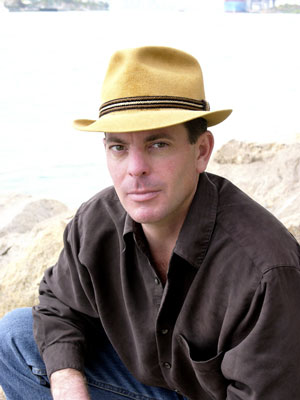
Sean Rowe writes:
By any objective standard, my life has been a long series of lucky breaks. I'll spare you the exotic travel on five continents - Antarctica included - bankrolled almost entirely by people other than myself; the full academic scholarships at Choate and the University of North Carolina at Chapel Hill, which I am increasingly, queasily, convinced were the result of some terrible twofer of a bureaucratic mix-up, a case of mistaken identity; nor will I get grandiloquent on you but merely state as fact that I have loved every woman I've ever slept with, even those who no longer return my phone calls. Instead I will focus here on the lucky breaks that relate most directly to my development as a writer.
My father spent his younger years working as a coal miner and railroad man, but he wound up becoming a linguist and professor of literature, an unlikely leap forward played out in the golden decade after World War II and smoothed along by the GI Bill of Rights. I myself came into the world a late child and pretty clearly an accidental one, though by no means unwelcome, and it was not long before I went to work. I became an eager rhesus monkey in my father's linguistic experimentations; my earliest memories are of sitting on his lap with a big red book out of which he taught me the 26 letters of our English alphabet, and after that how to prop up these curious symbols one against the other so as to form recognizable words. I was three years old.
I hasten to say that this was not child abuse, but good fun all around. Also I say this to prepare you for my description of Phase Two of my father's tutelage. Not only did my old man teach me to read at a freakishly early age, he read to me, continually, and his literary selections gave very short shrift to Dr. Seuss or Fun with Dick and Jane. No: his curriculum included such whoppers as The Iliad, Huckleberry Finn, Heart of Darkness, Moby Dick and Walden. Without any frame of reference, this seemed to me quite a natural sort of pre-schooling rather than what it might have appeared from the outside or in hindsight: a diabolical attempt to create of a pint-sized idiot savant, literary variety.
As has been stated elsewhere, a writer must do three things: read a lot, live a lot, and write a lot. So far, thanks to the wordy toddlerhood described above, I was well on my way to mastering the first of these dicta. But another lucky break intervened, one that confirmed me as a bookworm and also planted the germ of the notion that I might someday write books myself.
In 1975 my family moved to Finland, where I had my eleventh birthday aboard a Baltic passenger ferry (for lunch I ate antelope and cantaloupe, the sort of strange thing everyone should do, and brag about as much as possible, before dying) and where my father spent the next year teaching at the University of Helsinki on a Fulbright Grant. By now I could read on my own, of course, and I read both ambitiously and voraciously – as many as 100 works of fiction and nonfiction during the months of unbroken Arctic night. In addition to a precocious jump on my age mates (in terms of vocabulary and literary command), those Scandinavian evenings taught me the qualities of character that every writer must absorb, for better or worse: the crucial inner reserves and resources onto which the artistic temperament must fall back when all perceptible paths become brambly dead ends; and the auto-hypnotic capacity to escape therapeutically into stories and visions when the world proves dull or threatening, or both.
I had learned to read. Next I would learn to write, and rather late in the game. The first stage in this process was a baptism by fire called The Miami Herald.
Anyone who spent time in the Herald's newsroom in the late 1980s and early 1990s - or at any other time, I suppose - has his or her own war stories, more rococo with each retelling: riots and botched bank robberies and city council meetings turned donnybrooks and dashing, dangerous drug runners with names like Monkey Morales, and midnight assignations under the palms with one's own coked-out sidekicks. The point I should make is that there are many paths toward the life of a professional writer, and in my view one of the best is to get a job on a newspaper and be forced to write virtually anything, but on deadline. It worked for Mencken, it worked for Hemingway, and it's especially helpful if, like me, you are fundamentally lazy and an inveterate procrastinator.
Under the distant but watchful eye of the late Gene Miller, and with occasional encouragement from the princely Carl Hiaasen, I slogged along, wrote a few decent pieces and learned some good habits. My immediate supervisors managed to put up with my supercilious immaturity and after two years as a cub reporter I jumped ship to the sexier, upstart competition, a weekly muckraker built on the lines of the Village Voice.
Far too often, and not just at four in the morning, I wonder whether writing is simply a form of mental illness. Almost as often I ponder the musty question of whether writing – the art and craft of it – is teachable. Instead of holding forth on the latest evolution in this latter badminton match, let me present to you the circumstances in which I found myself in the autumn of 1991, which is to say the best possible circumstances a would-be writer could dream of.
I was still in my twenties. I had just been hired by what would turn out to be the two smartest editors I've ever worked with – Jim Mullin and Tom Finkel – at approximately twice the salary I'd earned at the Miami Herald. Not right away, but pretty soon, I had a cubicle overlooking the Port of Miami and the aquamarine waters of sunny Biscayne Bay. Died and gone to heaven, correct? But now consider the sparkler on the ice cream cake: when I asked my new bosses at the Miami New Times what they wanted me to write about, they said, in essence, "Whatever you want."
They turned me loose on America's gaudiest, most grotesque, most magical metropolis with a license to snoop, raise hell and spend real time learning the difficult work of long-form nonfiction. They gave me freedom, a degree of it that I will never, ever know again in my writing life.
So there you have it, except for the latest lucky break in my writing life, the one that turned my attention from journalism to fiction, and the one I hope inspires you to sprint to the bookstore in September and buy my first novel, a palm-studded page-turner published by Little, Brown and Company entitled, simply, Fever.
Shortly after midnight in mid-January six years ago, I was showing off for a group of friends. I was demonstrating how my cousin Doug and I used to squash coins under the wheels of locomotives. While my friends and I waited for a slow-moving freight to pass by on the tracks in downtown Fort Lauderdale, I knelt and slipped a nickel between the wheels of a boxcar.
Then I stood up, pleased with myself, and walked backward into the path of a second train coming from the opposite direction. The light and sound from the first train masked that of the second, so I didn't hear or see a thing. I didn't feel anything, either, until I woke up, briefly in the ER, and for slightly longer stretches in the intensive care ward, with a fractured skull, broken ribs, a collapsed lung and a dislocated shoulder. While the first train had been idling along, the second wasn't; it slung me across six lanes of traffic. By one account I flat-lined in the ambulance.
How could this catastrophe be considered a lucky break? It was a lucky break because, amid the urinary catheters and nasogastric tubes and chest pumps, I learned who my real friends were – the ones who stopped by, called, or checked in. Every day I got to watch my favorite TV show, Columbo, while shot up with enormous amounts of morphine, a pleasure that should rank near the top of any sybarite's to-do list. Most important, I had absolutely no excuse to put off writing the book I'd been working on by fits and starts, but never on all eight pistons.
When I got out of the hospital I left Miami, and journalism, forever. I moved to a friend's garlic farm in North Carolina and spent the next two years healing up. Gradually I lost the night terrors, the dizzy spells, the white spots in front of my eyes. The memory lapses became less frequent, the Percocet less necessary.
Last summer a literary agent named Sarah Burnes called and asked how quickly I could get to New York. "Nine days, if I start now and walk fast," I said. "Get on a plane," she suggested, in that unamused, multitasking tone I have come to associate with astonishingly brilliant, up-and-coming, put-together, real busy female Manhattanites.
So it was that I ate foie gras for the first time in my life, rode in yellow taxicabs, and was briefly the focus of a small and head-swelling bidding war. I returned from New York to my friends' garlic farm with a six-figure advance, a two-book deal, and the prospect of a new lease on my own curious life of letters. We'll see how it all plays out.
Around the time of my TKO by freight train, I stopped dreaming. That is to say, I don't remember any dreams I may have had upon waking; a shame, since I used to enjoy recounting my nocturnal adventures over breakfast and speculating about their meaning and vivid originality.
But six years into this unsettling lacuna I still keep a notebook and a pen on my bedside table. One fine midnight I know the cross-town freights will wake me out of the subterranean caves where myths and legends come from. The dreams will be there, waiting for me again.
While I wait for that I spend my mornings at the keyboard by a sunny window, dreaming on paper. Just the chance to do that may be the luckiest break of all.
Sean Rowe has been a reporter for the Miami Herald and senior writer for the Miami New Times. He lives in North Carolina, where he is renovating a turn-of-the-century farmhouse and working on his next novel.
